

Sri Lanka proudly wears the mantle of the ‘Green Paradise’ of the world, where verdant vegetation flourishes in every corner. Among its most notable features are its lush rainforests, named for their abundant rainfall that sustains their vibrant ecosystems. Covering a mere 6% of the Earth’s surface, these rainforests boast towering evergreen trees, dense jungle undergrowth, and a hot, humid climate. Our enchanting island is home to three main rainforests, including one UNESCO World Heritage site, each a treasure trove of biodiversity and unparalleled natural beauty.
Day 01
Peak Wilderness Sanctuary
The Peak Wilderness Sanctuary is a tropical rainforest and the third largest natural reserve in Sri Lanka. It derives its name from the surrounding areas of Adams Peak, Pidurutalagala and Horton Plains. Since all the foot paths to Adams Peak falls across this forest, this sanctuary holds a spiritual and cultural value. This eco system also provides refuge to abundance of endemic biodiversity, making it as one of most important conservation areas on the island!


Day 02
Knuckles Mountain Range
Knuckles Mountain Range is located in the districts of Matale and Kandy which consists some of the most heavenly nature trails in Sri Lanka. It was named as Knuckles, because it resembles a clenched fist of knuckles featuring 34 peaks and out of them 5 peaks are popular among adventure lovers as well as nature lovers. Due to its worthiness, Knuckles has been listed as a UNESCO World Heritage Site as well as considering as one of the main eco-tourism spots in the country. Trail along cloud forests, discovering unique flora and fauna, stunning views of nature and witness breathtaking panoramasfrom sheer points.


Day 03
Sinharaja Rainforest
Located in South-West in Sri Lanka, Sinharaja Rain Forest is one of the jewels in the island which has received international significance and has been designated a Biosphere Reserve and natural World Heritage Site by UNESCO. It is proved that rainforest likely formed during the Jurassic era (from 200 million years to 145 million years ago). This forest encompasses a span of 36,000 hectares and Sri Lanka plans to quadruple the size of the protected area inside since it is the viable area of primary tropical rainforest.
Sinharaja forest is wrapped in deep legend and mystery. According to legends, Sinharaja derives its name because in the past a lion king (Sinha raja) has been lived in this forest and protected it.
It is one of the most important amazing bio diversity hotspots in Sri Lanka identifying more than 60% of its trees as endemic and many of them as rare. Furthermore, the forest reserve is home to more than 50% of Sri Lanka’s endemic species of mammals such as langur monkey and the large squirrel, butterflies, as well as many birds including 33 species endemic to Sri Lanka. In addition, you can spot insects, wealthy reptile populace, myriads of bugs species, and rare amphibians. It is the densest vegetation rain forest in Asia.
This rainforest sheltering most of the endemic animals including bird species making it as a paradise for bird-watching lovers, such as Red-faced Malkoha, Green-billed Coucal and Sri Lanka Blue Magpie; out of 12 endemic mammal species of the country 8 are found here, reptiles include the endemic Green pit viper and Hump-nosed vipers, and many amphibians as well.
On the other hand many threatened species of mammals, reptiles, amphibians and butterflies are found in the Reserve including the leopard (Panthera pardus), Indian elephant (Elephas maxiumus), endemic purple-faced Langur (Presbytis senex), Sri Lanka wood pigeon (Columba torringtoni), green-billed Coucal (Centropus chlororrhynchus), Sri Lanka whiteheaded starling (Sturnus senex), Sri Lanka blue magpie (Cissa ornate), ashy-headed babbler (Garrulax cinereifrons) and Sri Lanka broad-billed roller (Eurystomus orientalis irisi). Hence Sri Lanka is expanding the reserve for the sake of future. The new reserve will span 36,000 hectares (88,960 acres) and will help conserve a biodiversity hotspot.
Trek through picturesque paths, thick canopy of trees and adventurous jungle trails and enjoy eye-opening experiences of this marvelous Mother Nature. Along the way, get some rest in better way! Take a dip in and refresh yourself in a shimmering stream you encounter. The pleasant time to go for a trek in Sinharaja Forest Reserve is both among January to May and August to December, just keeping away the monsoon season.

Journey Highlights
- Spotting endemic flora and fauna
- Observing the beautiful greenery of mother nature
- Hiking through off beaten tracks
- Absorbing mesmerizing stories behind natural UNESCO World Heritage Sites
- The sacred footprint – Adam’s Peak where a stunning sun rise gives you the chills
- Vistas of the mighty Knuckles mountain range
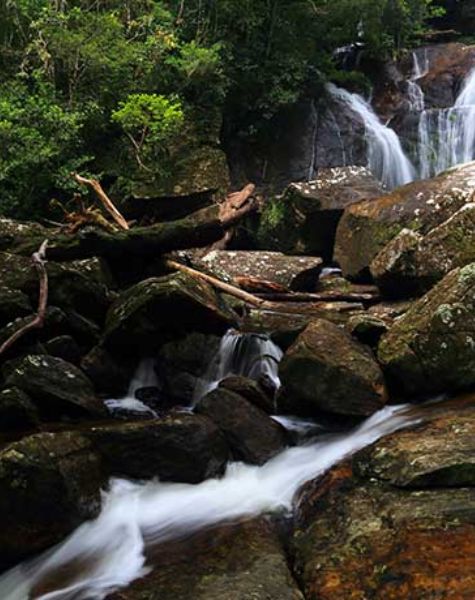
- Breathtaking waterfalls in Sinharaja rain forest
- Balangoda View Point
Places you will stay

Dumbanagala Chalet
hunnasgiriya

Corbets Bungalow
Hunnasgiriya

Nestwood Bungalow
Kalawana

Sinharaja Rain Forest
Sinharaja
Insightful Tips
- Be prepared to expect leeches, so wear leech socks and keep insect repellant with you.
- Remember to take plenty of water to stay hydrated.
- Take your rain protection kits with you to face bit challenging torrential rain.
- Do not miss your power bank and camera to capture beautiful shots.
- Brace yourselves for “no internet connection” – Its 90% talk with nature, 10% surfing the internet
FAQ
Q. How far is Sinharaja from Colombo?
About 140km away from Colombo and it would take around 03 & ½ hours to drive time.
Q. What is the best time to visit Sinharaja?
Between January to May and from August to December.
Q. How many days would take to explore Knuckles?
You will need at least 02 days.
Q. How long does it takes to climb Adams Peak?
Approximately 04 hours. It is depending on your fitness & efficiency level.